Have you ever encountered this situation?
Parts printed near the center of the build chamber come out perfectly, while those near the edges warp or crack. Or, when printing a full build plate of small parts, some meet specifications while others must be scrapped.
This is not a matter of luck. The problem may be uneven chamber temperature.
Most desktop and conventional industrial FFF 3D printers can provide heat only within localized areas. They cannot maintain both a high temperature and a uniform thermal environment throughout a large build chamber. Achieving a high chamber temperature depends on the heat resistance of the machine’s components and the stability of its power system. Maintaining chamber temperature uniformity requires comprehensive thermal management across the machine structure, airflow design, control algorithms, and printing process.
The FUNMAT PRO 610HT delivers both. It features an actively heated chamber capable of reaching 300°C, with chamber temperature performance verified through independent nine-point testing. This combination distinguishes the 610HT from conventional high-temperature 3D printers and provides the foundation for the repeatable production of large, precise parts made from high-performance materials.
High Chamber Temperatures: Enabling High-Performance Materials and Preventing Print Failure
1. Supporting High-Temperature, High-Performance Thermoplastics
Machines with lower chamber temperatures are generally designed for conventional materials such as ABS and PLA. An industrial-grade, actively heated chamber provides the processing conditions required for advanced thermoplastics such as PEEK, PEI, PPSU, and PEKK, supporting the production of high-value parts for aerospace, automotive, medical, and other demanding industries.
2. Reducing Material Shrinkage and Internal Stress
High-performance thermoplastics can experience significant shrinkage as they cool after extrusion. A high-temperature chamber slows the cooling process and reduces thermal gradients and interlayer stress.
This helps minimize hidden cracks, internal defects, and stress concentration in thick-walled or solid parts, improving their structural strength and dimensional stability.
3. Improving Interlayer Bonding
A high-temperature printing environment allows each deposited layer to remain at a more favorable temperature for interdiffusion and bonding. This reduces weak interfaces, delamination, and insufficient interlayer strength.
The result is more balanced mechanical performance throughout the printed part, helping components meet the load-bearing requirements of industrial applications.
Chamber Temperature Uniformity: Verified by Data
A high chamber temperature determines whether a machine can print high-performance materials. Chamber temperature uniformity determines whether it can print them reliably, with high yields and consistent results.
This is one of the key characteristics that distinguishes industrial FFF systems from desktop 3D printers.
The chamber temperature uniformity of the FUNMAT PRO 610HT is not simply an abstract specification. It is supported by measured data from an independent testing organization.
At a chamber setpoint of 300°C, the temperature uniformity measured across nine locations throughout the chamber was approximately 10°C. This means that even under extreme high-temperature operating conditions, the thermal field inside the 610HT remains tightly controlled at an industry-leading level, effectively reducing the common temperature imbalance found in conventional printers, where the center is hotter, the edges are cooler, and significant temperature differences exist between the upper and lower areas of the chamber.
A uniform chamber temperature delivers four major benefits.
1. Lower Deformation Risk and Improved Accuracy for Large Parts
Temperature differences are a major cause of warping, edge lift, and cracking. When the entire chamber maintains a uniform thermal environment, the part heats and cools more consistently, reducing localized stress concentrations.
This significantly lowers the risk of warping and interlayer cracking in large structural parts while improving dimensional stability and process control.
2. Greater Consistency in Batch Production
When multiple parts are printed across a fully loaded build plate, the parts at the center, edges, upper areas, and lower areas should experience comparable processing conditions.
A uniform thermal field helps maintain consistent dimensions, density, surface quality, and mechanical properties throughout the batch. It reduces the risk of producing different results within the same build, minimizes manual sorting and inspection, and supports standardized factory production and quality-control requirements.
3. Better Results for Thin-Walled and Fine Features
Thin walls, lattice structures, and fine geometries dissipate heat quickly and are highly sensitive to temperature changes.
A uniformly heated chamber helps prevent localized rapid cooling that can cause incomplete features, visible layer lines, structural collapse, and insufficient interlayer bonding. This improves both the structural integrity and surface quality of intricate parts.
4. Lower Setup and Production Costs
When the thermal field remains consistent throughout the build chamber, users do not need to repeatedly adjust process parameters according to part position.
This improves material and process compatibility while reducing parameter-development time, rework, failed builds, and material waste.
From “Printable” to “Production-Ready”
A high chamber temperature expands the range of printable materials and supports the required part performance. Chamber temperature uniformity provides the stability and consistency needed for production.
Together, they enable FFF to evolve from an unstable, sample-level process into a standardized industrial production technology.
✓ Print high-performance materials successfully
✓ Produce large parts accurately
✓ Manufacture batches consistently
✓ Form precise structures reliably
Application Examples
Case 1: Large High-Performance Parts
Application scenario: Large structural parts and complex functional components for aerospace and automotive tooling, printed using high-temperature engineering thermoplastics such as PEEK, PEI, and PPSU. These materials are highly sensitive to temperature. In conventional printers, significant temperature differences between the chamber center and edges or between the upper and lower areas can easily cause edge warping and interlayer cracking when printing large parts.
Thermal support: Independent nine-point temperature measurements demonstrate that the 610 × 508 × 508 mm build chamber of the FUNMAT PRO 610HT maintains a uniform thermal field throughout the chamber. At a chamber temperature of 300°C, the measured temperature uniformity was approximately 10°C. During printing, the entire part experiences more consistent heating and cooling rates, reducing thermally induced stress at the source.
Result: When printing large PEEK or PEI structural parts and large automotive mold inserts, the risk of warping and interlayer cracking is significantly reduced, with noticeably less deformation around the part edges.
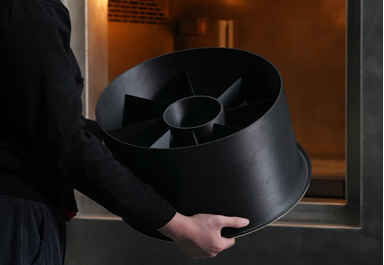
PEEK-CF high-performance material part.
Case 2: Consistent Parts Across a Full Build Plate
Application scenario: Full-build batch production of medical components, electrical insulation parts, and small precision automotive components. A common challenge with conventional printers is uneven chamber temperature, which can cause parts printed at the center and edges of the same build plate to exhibit differences in strength, dimensional accuracy, and surface quality.
Thermal support: Independent nine-point full-chamber testing verified that temperature variations throughout the upper, lower, left, right, front, and rear areas of the build chamber were controlled at approximately 10°C at a 300°C setpoint. When the build plate is fully loaded, each part is produced in a highly consistent thermal environment, helping maintain comparable interlayer bonding, material crystallization, and cooling shrinkage across the entire batch.
Result: Dozens of small precision parts can be printed in a single build with highly consistent dimensions, strength, and surface roughness. Parts near the edges are less likely to exhibit localized softening or deformation. This significantly improves batch stability and supports standardized factory inspection and volume delivery requirements.
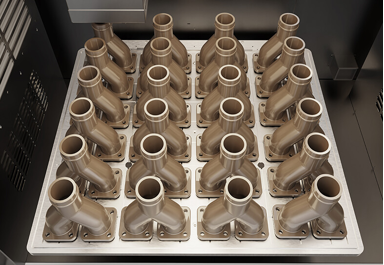
Full-build batch production: consistent parts with minimal variation.
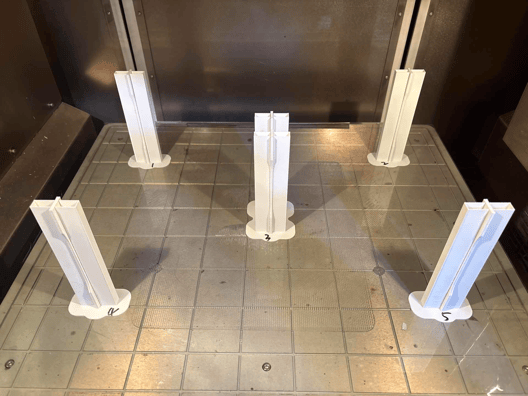
Thin-walled and precision parts: a uniform chamber temperature supports the complete formation of fine features.
Independent tensile testing further verified the consistency of the printed parts:
- Tensile strength: Six PC-FR specimens showed a range of 3.60 MPa and a coefficient of variation of approximately 2.8%.
- Elastic modulus: The range was 219 MPa, with a coefficient of variation of approximately 3.7%.
- Total elongation: Results were tightly grouped between 1.9% and 2.2% across all six specimens
Under an industrial FFF process, the coefficients of variation for the key mechanical properties of six consecutively printed specimens remained below 4%. This demonstrates the direct value of a uniform thermal processing environment across the entire build platform in achieving consistent mechanical performance throughout a production batch.
Case 3: Complex Thin-Walled and Lattice Structures
Application scenario: Precision jigs and fixtures, thin-walled aerospace components, and lightweight lattice structures. Thin walls and open structures have limited thermal mass and dissipate heat quickly, making them especially sensitive to chamber temperature uniformity. In conventional equipment, localized low-temperature zones can cause thin-walled areas to cool too quickly, resulting in weak interlayer adhesion, visible layer lines, structural collapse, and incomplete features.
Thermal support: The uniform thermal field of the FUNMAT PRO 610HT surrounds the part with a stable, consistently heated environment, minimizing localized cold zones. When printing thin walls and fine lattice structures, the chamber maintains stable thermal conditions throughout the process, allowing each deposited layer to melt and bond uniformly and helping preserve delicate geometries.
Result: When printing thin-walled structures measuring 1–2 mm and complex lattice geometries, the process can achieve virtually no collapse, discontinuities, or pronounced layer lines, while maintaining a smooth and uniform surface finish. Consistent interlayer adhesion also produces more balanced mechanical properties throughout the part, reducing the risk of localized weak areas.
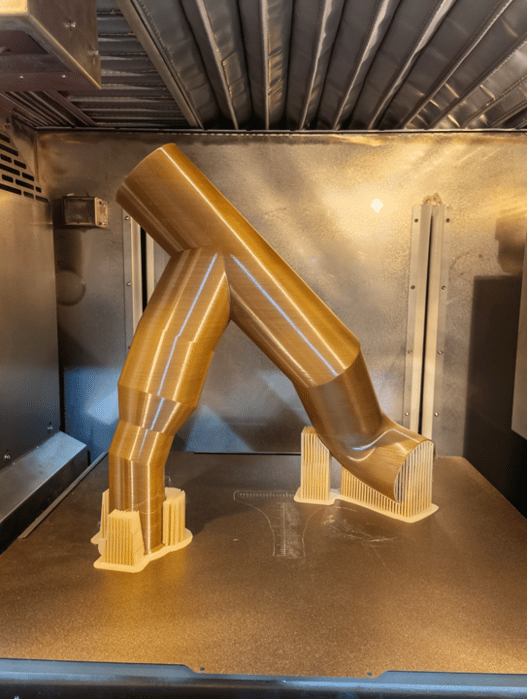
Large Y-shaped duct printed on the FUNMAT PRO 610HT: an example of large-format, high-performance part production
───────────────────────────────────────
The chamber temperature uniformity of the FUNMAT PRO 610HT is not an abstract specification. It provides tangible industrial manufacturing benefits.
Smaller temperature differences. Less deformation. Greater consistency. More stable yields. Broader material compatibility.
Independent nine-point full-chamber temperature testing by a CNAS-accredited laboratory enables large-format, high-precision, batch production with high-performance materials to move beyond trial and error, repeated parameter adjustments, and rework—toward truly standardized, stable, industrial-scale manufacturing.
.png?width=520&height=294&name=%E5%85%A8%E7%B3%BB%E5%88%97peek2-en-%20(1).png)